Modern Bathroom Design Ideas: 5 Color Schemes, Floors and Walls

What makes a bathroom modern, five color schemes that work in it, and the floor and wall materials that cope with water. Try them on your own plan first.
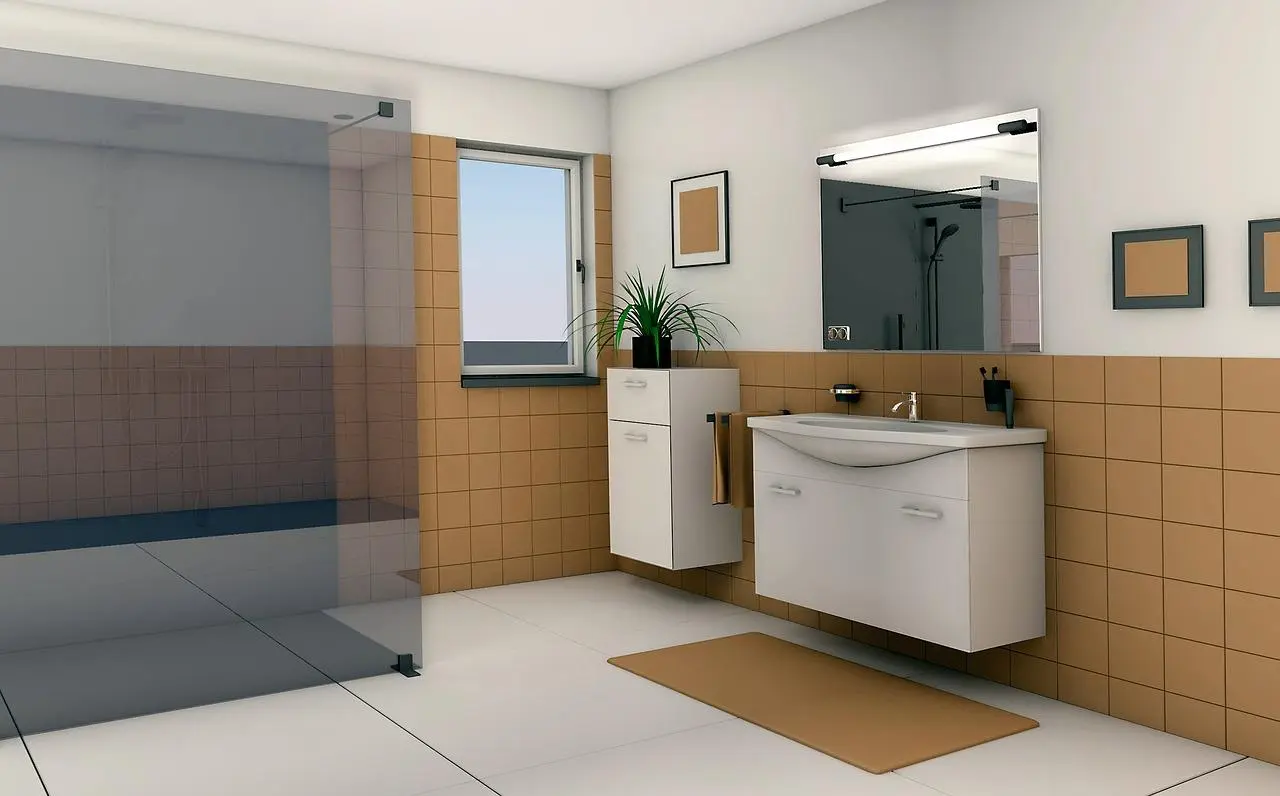
You see your bathroom first thing in the morning and last thing at night, usually before you are fully awake. It is the most personal room in the home, and the one that gets wet, hot and steamy every day. So it has to work before it can look good.
Interior trends help here. They change more slowly than fashion, and they bring functional solutions, not only decorative ones. Below are modern bathroom design ideas you can test on your own room: what the style is, five color schemes, and the floor and wall materials that cope with water.
What is modern bathroom design?
Modern bathroom design puts function first: a clear layout with free space to move, items that are easy to use, and restrained decor with clean lines and varied textures. It has no strict rules, only a few shared principles.
The style began as a reaction. Artists once rejected the old canons to make new art, and modern design grew in the same way, from principles opposite to classical ones. A traditional interior relies on clear means of expression, a strict composition and subject content. A contemporary one adapts to the home and the people in it, puts comfort first, and leaves room for one bold idea.
So what does a modern bathroom look like? These principles hold it together:
- Layout. Functional zones, plus empty space for free movement.
- Use. The room is made by people for people. Every item is easy to use and is part of a whole.
- Character. A modern base can carry unusual design objects, modern art or pop culture pieces.
- Decor. Restrained: smooth lines, clean shapes and a variety of textures.
- Color. It depends on the character of the room. In a concise interior, add a neutral palette and a few contrasting pairs for brightness.
- Materials. Artificial materials look right in a modern room. Recent trends lean back towards natural ones, so choose by the goal of your project.
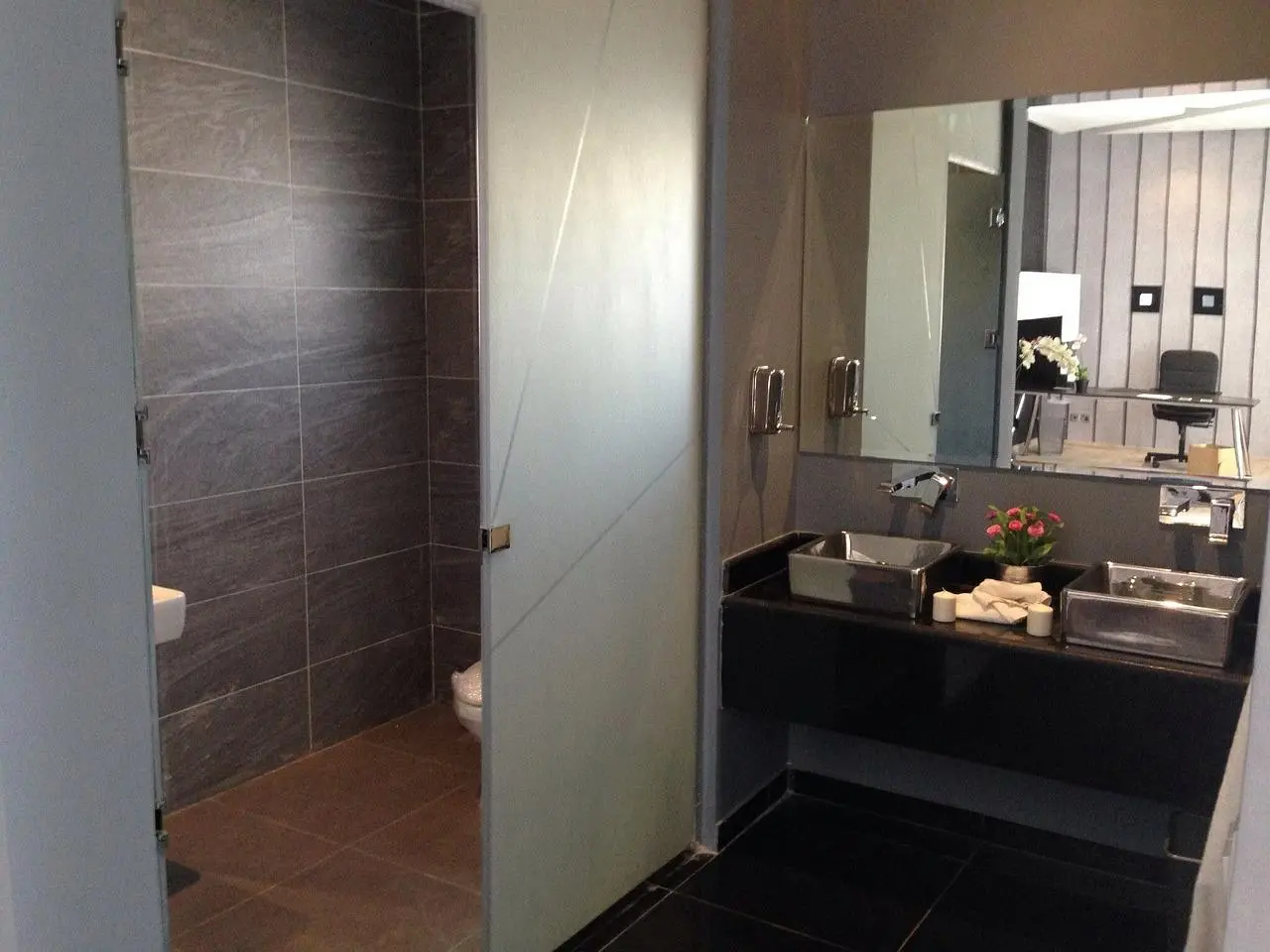
A bathroom is a practical room, so every choice has to earn its place.
Which modern bathroom color schemes work?
White, grey, black, brown and blue all work in a modern bathroom, as long as each sits inside one harmonious scheme. Here is what each color does and what it asks of you.
White: space that shows every mark
White goes with every other color. Use it on the walls, the ceiling and the sanitary ware.
Why it works: as the main color, white makes a bathroom with a shower feel spacious and a little "sterile". The trade-off: white surfaces get dirty fast. Choose materials that are easy to clean, and add one dark accent so the room does not look flat.
Grey works when you add texture
Grey pairs with monochrome or contrasting shades. It feels strict and restrained, but also mature.
Why it works: it is a quiet base for the rest of the room. The trade-off: grey can look cold. Vary the textures of the materials, and use lighting to bring the room to life.
Black needs a large room
Classic styles use black in small details and rarely as a main element. A modern bathroom can give it a bigger role.
Why it works: black goes with almost the whole palette and gives the room depth. The trade-off: that depth can feel heavy. Keep black for spacious bathrooms, and pair it with natural or less saturated shades.
Brown: a classic in modern forms
Brown can stand alone or come from natural wood surfaces. It suits a restrained modern bathroom with solid, monolithic volumes.
Chocolate, brick and coffee shades look noble. A brown room carries a quiet classic feeling inside modern shapes.
Blue belongs on the walls
Blue often turns into a marine theme, because it reminds people of water. But blue alone already gives a calm, soothing mood, and that suits a bathroom.
Use blue mainly on the walls. Light wood furniture and white items look good against it.
Common mistake: adding a full sea theme to a blue bathroom. The color already gives the calm; the room does not need a theme on top of it.
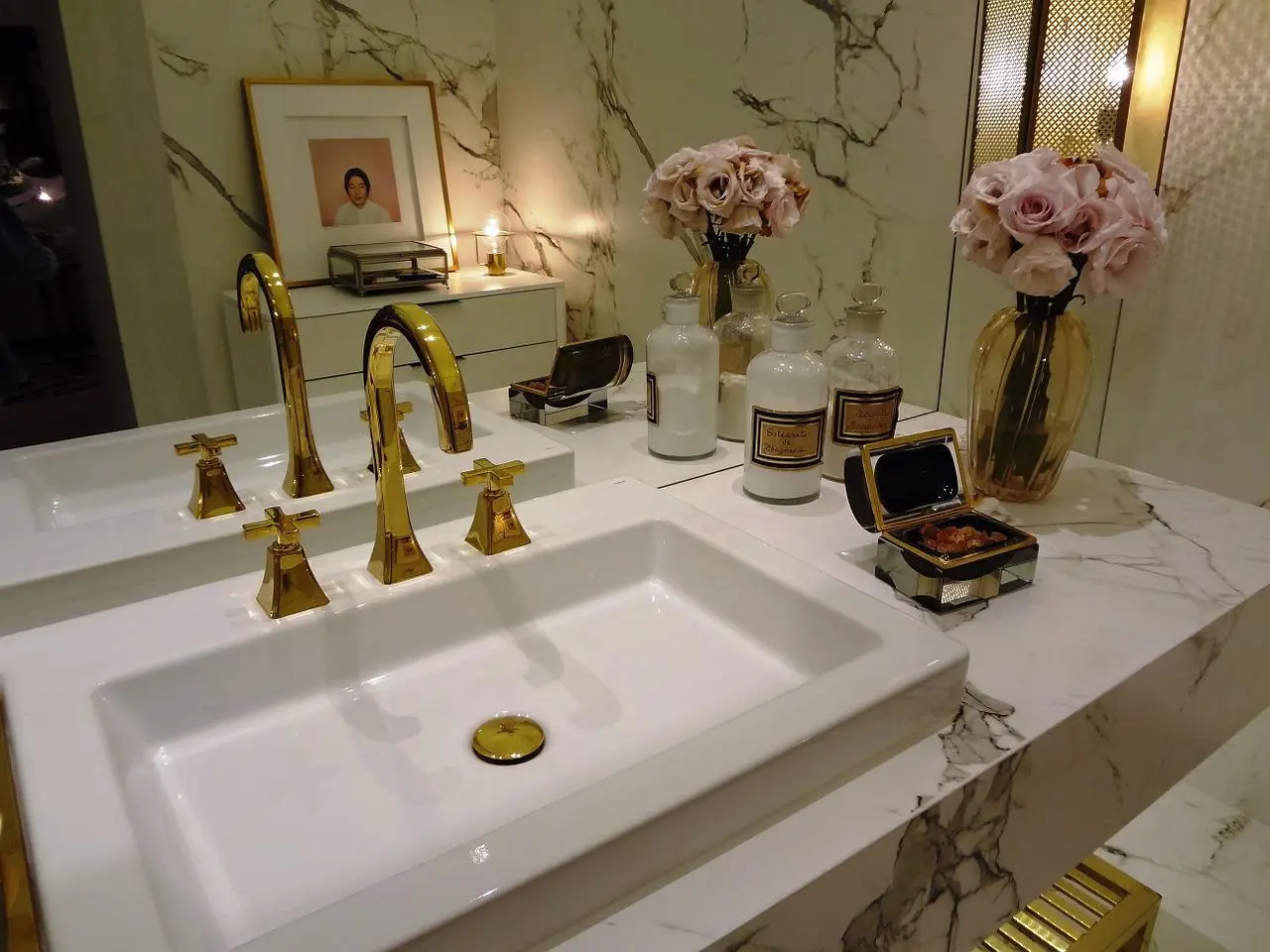
Which modern bathroom floor material should you choose?
For most modern bathrooms, ceramic tile or porcelain. A self-levelling floor and wood are bolder options, and wood costs more.
Finishes in a modern bathroom have only practical requirements. The look can change with your design.
| Material | What it gives you | What to keep in mind |
|---|---|---|
| Ceramic tile | Resists water and high temperatures, easy to clean | The traditional choice; pick it by pattern, size or shape |
| Porcelain | Good performance and a non-slip surface for a room that is always humid | Fits best when the room leans towards classic |
| Self-levelling floor | Any image you want, from the sea floor to abstract compositions | The glossy surface makes the image look more real |
| Wood | A natural, living look | Costs more, because it needs protection from moisture |
Ceramic tile has been the bathroom floor for a long time, and for good reason: water and heat do not damage it. Porcelain became popular for its performance, and the non-slip surface matters most in a wet room. Wood does not tolerate humidity well on its own, but many people find its natural look worth the extra effort.
Wall finishes: from paint to natural stone
The walls give you more choice than the floor. Paint costs the least, and natural stone costs the most.
- Paint is the most budget-friendly finish. It suits walls with small defects that ordinary putty can hide, and you can choose a matte or glossy finish.
- Wallpaper works only if it is moisture-resistant, never paper. It is easy to care for, but it lasts less than the other materials.
- Ceramic tile is the most popular wall finish, as on the floor. Hexagonal tiles are in fashion now, on a whole wall or only on some areas.
- Plastic panels imitate other textures.
- Natural stone is the most expensive, but only stone gives both a luxurious and a minimal look.
Common mistake: paint on an uneven wall. Paint hides only small defects that putty can fill, so fix the wall first or choose tile.
How to design a modern bathroom on your own plan
Draw your bathroom in Home Planner and try colors and finishes on it in 3D before you buy anything.
Measure your space and make a 2D/3D floor plan. Change the floor and wall materials: white against blue, tile against wood. Furnish the room with items from world-famous brands, then make a realistic visualization of the result. If you prefer a starting point, open one of the predesigned layouts for a bathroom, bedroom or living room.
A color scheme is easier to judge on your own walls than on someone else's photo. Home Planner is free to start on iPhone, iPad, Android, Mac and Windows.
Trademark notice. Home Planner is not affiliated with, endorsed or sponsored by Apple Inc., Google LLC or Microsoft Corporation; their names and marks belong to their owners. iPhone, iPad and Mac are trademarks of Apple Inc., registered in the U.S. and other countries. Android is a trademark of Google LLC. Other trademarks are the property of their respective owners.
Try it on your own project
Free room planner and interior design app