How to Mix and Match Bathroom Tiles: 5 Stylish Ways

Colours and patterns by style, colour placement that changes how big the room feels, mosaic, and unusual shapes and layouts.
You have found a bathroom tile you like. Now you hold a second sample next to it and ask the hard question: will they work together, or will the room look busy? Interior design depends on many things, and most of all on how you see it. The bathroom needs extra care, because it has to look good and work well every day.
Here is how to mix and match bathroom tiles in five ways: by style, by colour placement, with mosaic, with unusual shapes, and with an unusual layout of ordinary tiles.
Can you mix tiles in a bathroom?
Yes. One tile on every surface suits a minimalist design, but in most bathrooms a mix of tiles looks better.
Tile is the most popular material for bathroom walls and floors, so it sets the tone of the whole style. One tile everywhere is the easy choice, and in most cases the result looks featureless. A considered mix keeps the bathroom a room you feel comfortable in.
The difficult part is the choice itself. Tiles now come in so many styles, shapes and colours that it is easy to get lost. The five ways below narrow it down.
What does mixing tile sizes in a bathroom do?
It creates an artistic effect, divides the room into zones and sets accents. That makes size a planning tool, not only decoration.
A change of tile size can mark the place of an object that must be there, such as a light fitting. It can also frame the sink zone and everything on the same vertical line with it. There are many variations, and you can find one for almost every bathroom.
How do you pair two different tiles in a bathroom?
Start with the style you prefer. It decides which tiles go together, and which colours and ornaments they carry.
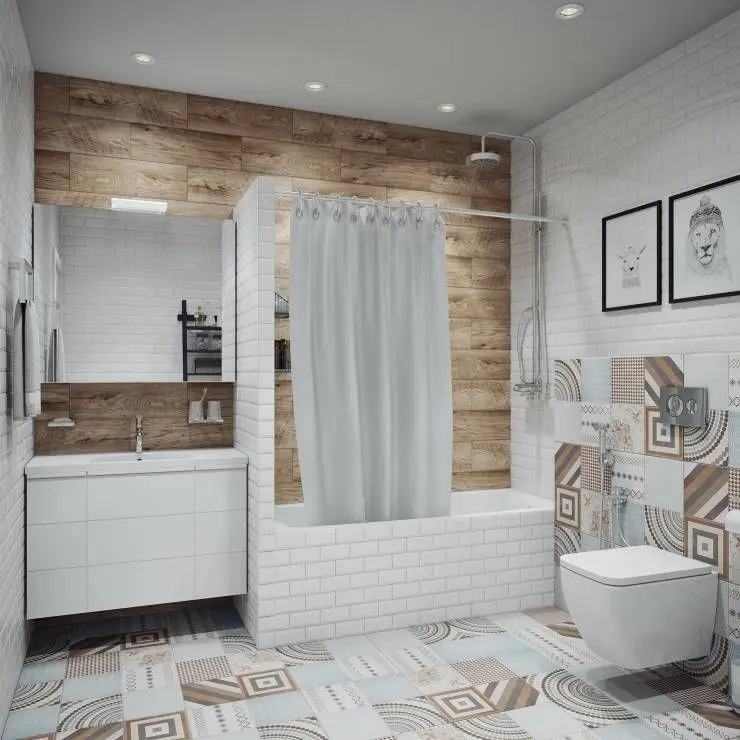
Scandinavian. A light Scandinavian style gives a calm look in warm or cold colours, and it handles two or more types of tile in one room. Combine white tiles with ornamented ones, and perhaps add a wood-look pattern.
Minimalist. Here you mix tiles to divide the space, or just to make a shower room look more stylish. Choose tiles in the same shade, with little difference between them. The variety then comes from different shapes, not from colour. Light sets the accents and holds the style together.
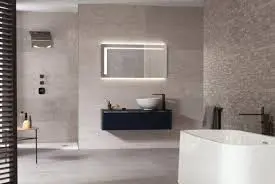
Grey stone-look tiles in one tone: the backlit mirror carries the accent.
Bright. These are only two examples. If you want more energy, use bright colours and ornaments. That choice depends only on your taste.
Use colour to change how big the room feels
Colour can visually change the size of a bathroom. Its position on the walls, floor and ceiling has a strong effect on how you see the space, especially when you combine light and dark tiles with high contrast.
This works at both ends of the scale. You can find ideas for a tiny shower room, and for a bathroom as large as an average living room. If your bathroom feels too small or too big, plan the colour of each surface before you buy. The right combination corrects how the space looks.
The trade-off: high contrast has the strongest effect, so a wrong placement is also easier to see.
Which mosaic tile bathroom ideas work beyond the walls?
Use mosaic as an accent: on a wall, the floor or the ceiling, or on a sink.
Mosaic draws the eye to the surface it covers. That surface does not have to be a wall, a floor or a ceiling. You can use mosaic pieces to create a unique sink, or to decorate any other surface you choose.
Handmade mosaic. For a sink like this, you set every piece yourself. Then you add a finish layer, so the mosaic lasts.
Ready-made mosaic. Most mosaic does not need that work. The mosaics on the market usually come attached to a special mesh, with a space between the pieces, so you lay a whole sheet at once. You can also find mixed tile designs with mosaic made for shower rooms. They are usually chosen by shades of one colour, or by one colour group: warm or cold, light or dark. Many of them have more than two colours. The design can be abstract or show a picture, and that makes little difference to the result.
Go unusual with the shape
Many people do not want a bathroom like everyone else's. They invent their own designs, or at least their own details. Tile suits this well, because it is a material you can use almost anywhere.
The most obvious step is an unusual shape. One example is mosaic that copies the scales of a mermaid's tail. It looks most natural in sky blue or turquoise. Another is the honeycomb shape, which has become very popular. It comes in many designs and colours, so you can choose what you like. Even in one colour, the shape changes the whole surface.
Lay ordinary tiles in an unusual way
A square tile can look boring. Lay it differently. Build a large mosaic from whole tiles and broken pieces of the same tile.
You can also combine glossy and matte tiles in one design. The tile stays the same; the surface does the work.
Try your combination on your own plan
There are many more ways to combine two or more tiles in a shower. In the end, every one of them depends on your taste and your ideas. A combination is easier to judge in your own bathroom than in someone else's photo.
To collect your ideas and turn them into a project, use the Home Planner App. Measure the room, create 2D and 3D floor plans, and furnish the room with products from well-known brands. The floor materials include plain, classic and mosaic tiles. Ready-made layouts for the bedroom, bathroom, living room and other rooms give you a place to start.
Try it on your own project
Free room planner and interior design app