Where to Place an Aquarium in an Apartment or House

Floor load, sunlight, noise and humidity decide where a tank can stand. The type of tank decides how much care it needs after that.
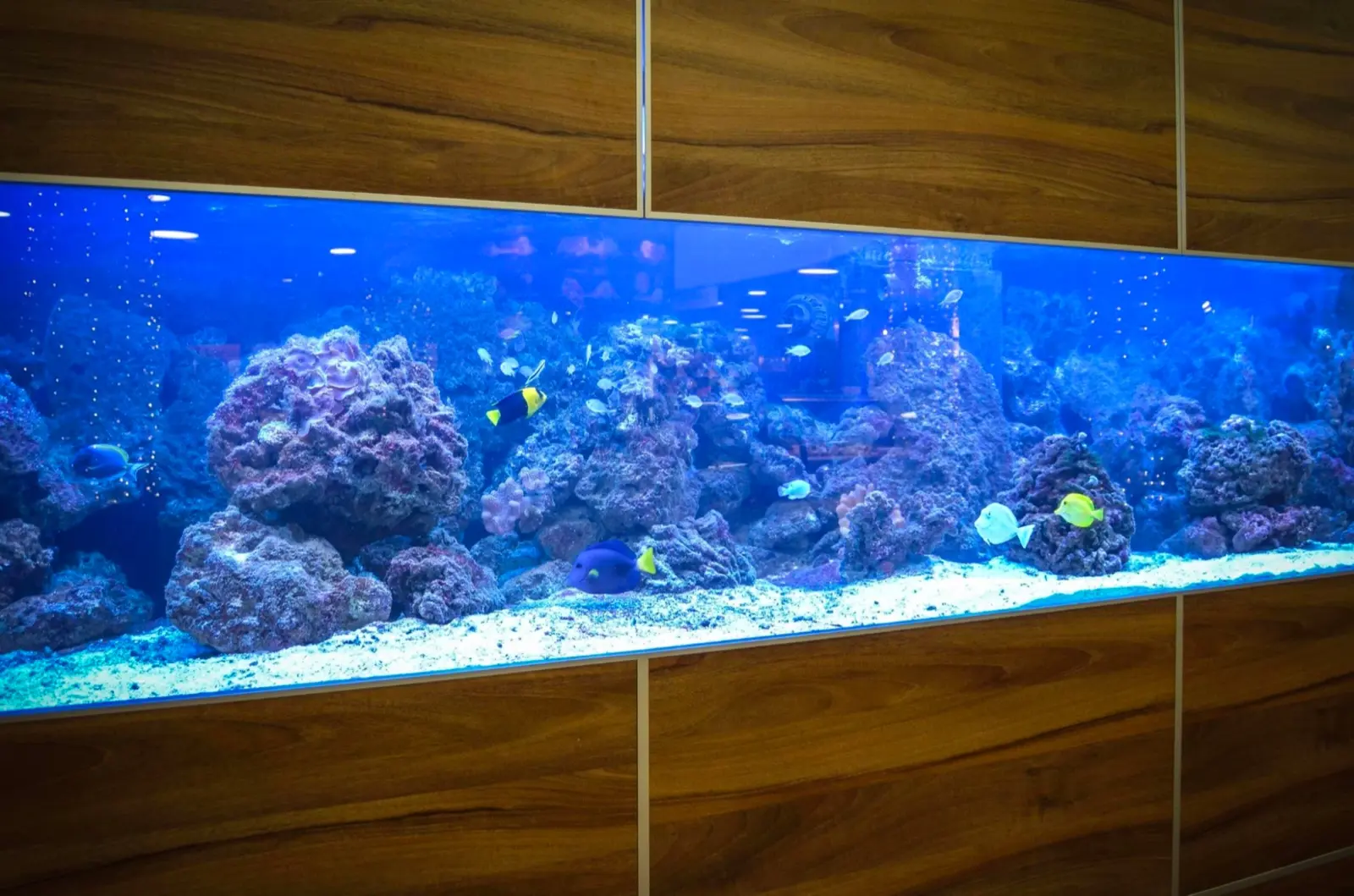
You have chosen a tank and a free spot by the window. Before you fill it, check two things the shop will not ask about: how much the full tank weighs, and how much sun that spot gets. A column of water only 60–80 cm high can already reach the load limit of a home floor.
This guide shows where to place an aquarium so that it stays safe for the fish, the floor and the people around it. Then it explains how much care each type of tank needs.
What an aquarium adds to a room
Most decor in a home stays still. An aquarium brings living things into the room. Bird cages and terrariums house animals too, but water adds something they cannot: colours that change with the light, and reflections that seem to move on their own. Watching fish also has a calming effect on the people who live with them.
The tank itself is only the frame. What goes inside matters more: sand, gravel, plants and coral, and the functional parts that keep the water healthy, such as the filter and the oxygen system. Choose them together with the tank, not after it.
Can you have an aquarium in an apartment?
Yes, even in a studio flat. Aquariums come in a very wide range of designs, and they suit homes of every size and most décor styles. In an apartment, the limits come from the floor, the light and the noise around the tank, not from the size of the room.
How much weight can a floor hold under an aquarium?
Less than most people expect. A conventional home floor slab is built for a load of 600–800 kg/m² (123–164 psf). Water is heavy: a water column 60–80 cm (23.6–31.5 in) high already reaches that limit.
Count the whole set, not only the water. Add the frame, the glass, the stand or table, and every accessory attached to the tank.
Common mistake: fish owners compare tanks by their dimensions and forget the weight. Check the weight first, and the look second.
Where to put the tank in a room
Safety comes first. Put the tank where nobody can tip it over, where it is not in the way of people walking past, and where activity around it cannot damage it. Stand it on a solid surface and, if you can, with at least one side against a wall.
Keep it out of direct sunlight. Sun causes two problems. It makes algae grow faster, so you clean more often. It also heats the water, and the fish can react badly to the change. Some owners think fish need sunlight the way people do. They need light, but not sunlight: the light fittings in the room or a lamp attached to the tank are enough.
Give the fish dark, quiet places. Some designs hang the aquarium from the ceiling, so you can watch it from several sides. People like the view, but it can stress the fish. They need dark and quiet areas to withdraw to when they rest.
Keep it away from noise and vibration. Fish need quiet as much as people do. Do not put the tank next to the speakers of a TV or music system, or near a washing machine or a dryer.
Why is an aquarium in the living room the safe choice?
Because the living room is where most of the household's day happens. That is the general rule for any tank: it gives you the most value in a room that sees a lot of activity every day. Most people put their aquarium in the living room for this reason, and guests can see the fish and the tank too.
Is an aquarium in the bedroom a good idea?
Only if the air is not humid already. Water evaporates from the tank, so the humidity around it rises, as it does near any body of water. In a humid climate, a bedroom tank makes the air heavier still. A dehumidifier solves the problem.
Does an aquarium in the kitchen work?
It can, if the tank stands away from heat and the water cannot reach anything electrical. Many home owners like the kitchen for a tank. Keep it at a distance from the stove and other heat sources, and away from sockets and appliances.
How much care does each type of tank need?
The type of tank and the fish that live in it decide how much work you do. Here are the main options, from the least work to the most.
Self-cleaning aquarium: the least work. Beginners and busy owners choose this type. These tanks are usually expensive. A multi-stage filter adds oxygen to the water and keeps conditions stable. With a good system, you only change the filter every few weeks.
Closed-top aquarium: the cheapest to clean by hand. The tank is covered on all sides, so little dirt gets into the water. The cover also blocks sunlight, which stops algae from growing.
Tank built into furniture or a wall: the most work. An aquarium wall in a house is almost impossible to clean yourself. If you choose one, plan for a professional cleaning service as well.
Freshwater or saltwater. Each type of water affects the tank differently. Grime usually builds up faster in saltwater tanks.
Try the spot on your plan first
If you have never used an aquarium as decor, at home or in the office, the first one can feel like a big step. Home Planner lets you test the spot before you buy anything. Measure your room, draw it as a 2D/3D floor plan, find an aquarium in the catalog and place it: against a wall, away from the window, out of the walkway. Then furnish the rest of the room with products from well-known brands, create a visualization, or start from a ready-made layout for a bedroom, bathroom or living room.
Home Planner is free to start. Try it on your own plan and see where the tank fits before the water goes in.

Try it on your own project
Free room planner and interior design app