Vintage Interior Design: Key Ideas, Materials and Rooms

What vintage style is, where it came from, the materials, objects and light that carry it, and how to give each room its own era.
A leather travelling chest from a thrift store. A grandfather clock that is too large for any modern flat. One old piece can change a whole room, and then a question follows: how far do you take it? Vintage interior design gives many answers, because "vintage" covers several generations of objects.
What is vintage interior design style?
It is a style built on themes and objects from the past, usually from 20 to 100 years ago. The word "vintage" means "made in the past". It began as a winemaking term for the year the grapes for a wine were harvested.
The style is popular across age groups, but two groups like it most.
- Older people. Vintage pieces bring back their childhood or youth. For them it is a way to remember and to celebrate a time that matters to them.
- Younger people with a favourite era. They like the quaint shapes and the colour palettes that look out of place today. Many of them do not want to follow the same trends as their friends.
How does vintage modern interior design work?
It puts old and new pieces side by side, so each one looks more distinct. This mix made the style popular, and it explains why vintage fits into homes of very different styles.
Most people do not furnish a whole home in vintage. They add a few small elements as highlights in a room. The trade-off is balance: one old piece in a modern room is a feature, but a few pieces from the wrong decades can look like storage.
Where did vintage style come from?
Vintage became a design trend around the turn of the 21st century. At that time, modern minimalism was everywhere, because its clean lines matched the technology boom. Not everyone liked it. Many people preferred the more elaborate, curved lines of the past.
Old décor was out of fashion, so design shops did not sell it. Vintage fans searched thrift stores and even junkyards instead. Each find was a matter of luck, and that gave vintage accessories their unique character.
This way of building a space attracted artistic people. Soon the people who set trends were choosing vintage too, and the style became "cool" by association. High-end designers started to buy the pieces that until then only thrift stores had. Prices went up, and vintage appeared in expensive restaurants, shops and homes.
What are the characteristics of vintage interior design?
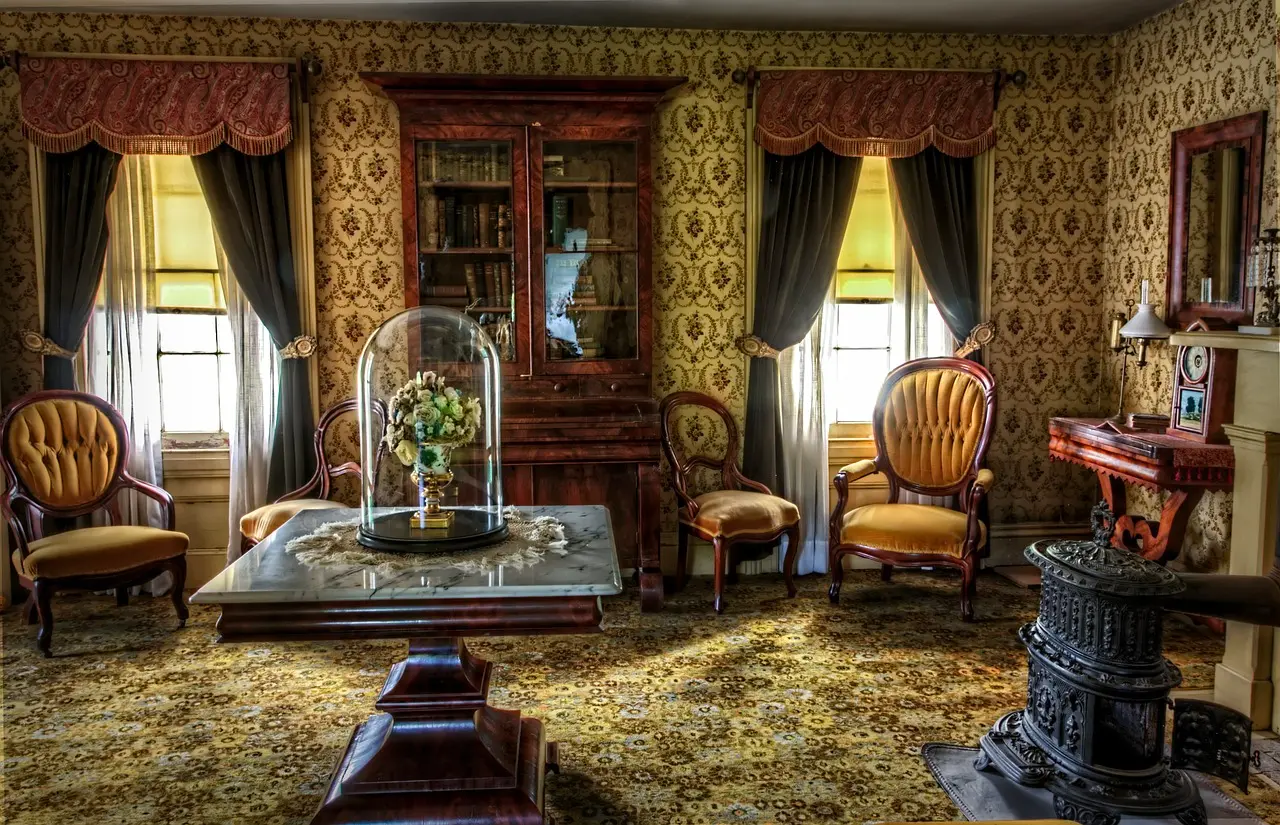
Authentic old objects, surfaces that show their age, and wallpaper from the era you choose. The details depend on the period, and because "vintage" covers such a long time, the range of elements is wide.
Authentic accessories are the heart of the style. It can be as simple as a vintage bathroom sign on the washroom door, or as large as a leather travelling chest or a grandfather clock.
Surfaces show the passage of time. Distressed finishes and chipped edges are part of the look.
Common mistake: new furniture with clean, sleek lines next to old pieces. It breaks the vintage look. Choose pieces whose surfaces show their age.
Wallpaper is a common feature. The pattern depends on the era you want to show. Neutral colours work as a background, and floral prints or straight parallel lines also work. For a 1950s look, add a mosaic of wall tiles.
Materials, objects and light
Wood and unpolished metal
Vintage fans turned away from many of the cutting-edge materials of their time. So traditional materials lead: wood and unpolished metal, with wood used most.
Wood has warm brown shades and a textured finish, and both suit a vintage room. You see it most often in tables, chairs, shelves and floors. Depending on the era, the wood has straight, simple lines or elaborate carving.
Large old technology
Early technology was large, and that size is one of the clearest signs of vintage. Take audio equipment: from gramophones to standalone speakers over 4 feet tall, everything was big. Computer equipment from that time looks stylish and is in high demand, so it can be very expensive.
Appliances such as refrigerators have a plain metallic finish. Faux vintage appliances use modern materials, with a coating that looks like stainless steel or the polished metals common in the 1950s.
Warm light
In the vintage era, light came from open flames or traditional light bulbs. Both give a warm yellow or orange glow. Vintage fixtures range from simple sconces to elaborate chandeliers.
Some cooler white light can break the monotony. Use a little, so it does not weaken the vintage feel.
How to decorate vintage style room by room
Give each room its own vintage era. The style covers so many periods that you have a wide choice of décor. One good approach is to go decade by decade from room to room, which suits people who like history.
- Dining room: colonial. Straight lines and an elegant look.
- Library or study: Victorian. The Victorian era was a time of many discoveries and inventions, so it suits a room for reading and thinking.
- Dining area and kitchen: the Titanic. The ship was famous for its showy décor and heavy ornament.
- Bedroom: Art Deco. This style was popular in the 1920s. Gilt fittings, a distinctive art style and clean lines make the bedroom a retreat within the home.
Each room keeps its own character, and together they show eras that are long gone.
Try your vintage era on your own plan
An era is easier to judge in your own rooms than in a photo of someone else's home. In Home Planner you can design your real home or an imagined one. Measure your space, create 2D and 3D floor plans, furnish rooms with items from world-famous brands, and make visualisations. If you need a starting point, use the ready-made layouts for a bedroom, bathroom, living room and more. Home Planner is free to start.
Try it on your own project
Free room planner and interior design app